



Does Your Child Constantly Walk on Their Toes?
Understanding the Causes of Persistent Toe Walking and How Early Physiotherapy Intervention Can Support Healthy Growth.
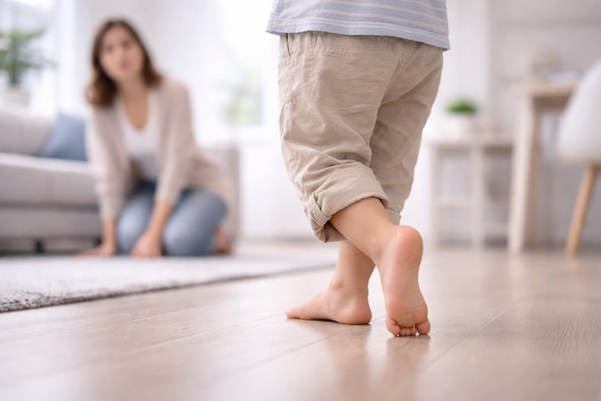

Observe your child walking casually at home. If their heels rarely touch the floor and they constantly balance on their tiptoes, you must ask: how long has this been happening? The answer defines your window of opportunity for correction before the condition becomes permanent and far more difficult to treat.
While children aged 1-2 often experiment with tiptoeing to find balance, a persistent pattern after age three—known as idiopathic toe walking—should not be ignored. Long-term toe walking progressively shortens the Achilles tendon and tightens calf muscles, which permanently restricts your child's range of motion.
One Gait, Three Very Different Causes

Toe walking is rarely just a habit; it can be a red flag for three distinct conditions:
- Idiopathic Toe Walking: A pure habit without neurological defects. Most responsive if treated via physiotherapy before age 7.
- Mild Cerebral Palsy: Often overlooked because toe walking is the only visible sign, despite underlying neurological coordination issues.
- Autism Spectrum Disorder (ASD): Research shows toe walking is significantly more common in children with ASD as part of their sensory profile.
Long-term Impact: Like a Tree Growing Crooked
A child's body is highly plastic. Imagine a young tree bound by wire; if removed early, it grows straight. If left, the deviation becomes part of its permanent structure. Persistent toe walking forces the knees and hips to compensate abnormally. Consequently, what starts as an ankle issue in childhood reappears as knee and spinal pain in adulthood.
When Should You Take Immediate Action?
The line between "monitoring" and "acting" is clear. If your child is over 3 years old and toe walking is dominant, or 5 years old and cannot place their heels flat on the ground, seek evaluation. Be particularly concerned if the tiptoeing happens on only one foot, as this may indicate an urgent neurological asymmetry.

Modern Physiotherapy: Beyond Basic Stretching
Superior physiotherapy does more than just stretch calf muscles. Modern approaches include strengthening the tibialis anterior muscles, balance (proprioception) training, and custom orthotics if necessary. The golden window for intervention is before age 7, while tissues are still plastic enough to respond optimally to correction.
Change a Child’s Future Through Pediatric Physiotherapy at UNPRI
Pediatric physiotherapy changes the trajectory of a family’s life. The Physiotherapy Undergraduate Program at Universitas Prima Indonesia (UNPRI) equips students with developmental science and clinical pediatric practice from the start. As the leading university in Sumatra, UNPRI produces proactive, evidence-based physiotherapists.

UNPRI graduates are prepared not just to "straighten" a child's gait, but to ensure every step taken from childhood leads to a healthy future without movement limitations. Superior physiotherapy is about saving potential before the window of opportunity closes.
News About "Ilmu Kesehatan:"
2026-04-20 11:10:44 by Muhammad Aditya Kurnia
Antara Fase Perkembangan Normal dan Tanda Adanya Gangguan Sensorik atau Motorik pada Anak

2026-04-20 11:10:44 by Muhammad Aditya Kurnia
Antara Fase Perkembangan Normal dan Tanda Adanya Gangguan Sensorik atau Motorik pada Anak

2026-04-20 11:10:44 by Muhammad Aditya Kurnia
Antara Fase Perkembangan Normal dan Tanda Adanya Gangguan Sensorik atau Motorik pada Anak

2026-04-20 11:10:44 by Muhammad Aditya Kurnia
Antara Fase Perkembangan Normal dan Tanda Adanya Gangguan Sensorik atau Motorik pada Anak

2026-04-20 11:10:44 by Muhammad Aditya Kurnia
Antara Fase Perkembangan Normal dan Tanda Adanya Gangguan Sensorik atau Motorik pada Anak
Other News

2026-04-20 11:10:44 by Muhammad Aditya Kurnia
Antara Fase Perkembangan Normal dan Tanda Adanya Gangguan Sensorik atau Motorik pada Anak

2026-04-20 11:10:44 by Muhammad Aditya Kurnia
Antara Fase Perkembangan Normal dan Tanda Adanya Gangguan Sensorik atau Motorik pada Anak

2026-04-20 11:10:44 by Muhammad Aditya Kurnia
Antara Fase Perkembangan Normal dan Tanda Adanya Gangguan Sensorik atau Motorik pada Anak

2026-04-20 11:10:44 by Muhammad Aditya Kurnia
Antara Fase Perkembangan Normal dan Tanda Adanya Gangguan Sensorik atau Motorik pada Anak

2026-04-20 11:10:44 by Muhammad Aditya Kurnia
Antara Fase Perkembangan Normal dan Tanda Adanya Gangguan Sensorik atau Motorik pada Anak