



Does Your Child Fall Frequently While Walking? A Physiotherapist Explains When It’s More Than Just Clumsiness
Identifying the Hidden Signs of Balance Disorders and the Importance of Early Physical Therapy to Support Your Child’s Physical Foundation

A four-year-old child falls seven times in a week—always to the left and usually when turning. While people say it's normal, parental instinct often signals otherwise. Frequently, this isn't due to clumsiness but is rooted in a balance system that hasn't developed correctly and has gone unnoticed by general observation.
If your child falls more than 2-3 times a day consistently, especially in the same direction or without an obvious trip, it's no longer just a learning phase. This is a specific diagnostic signal that requires a clinical evaluation by a professional.

The Triad of Balance Systems
Human balance is controlled by three interacting systems:
- Vestibular System: Located in the inner ear, it detects head position changes.
- Proprioceptive System: Located in muscles and joints, it tells the brain where the body is in space.
- Visual System: Uses visual cues to orient the body within the environment.
Consistent falling in one direction or during surface transitions indicates that one of these systems is underperforming or failing to integrate with the others.
Common Conditions Behind Frequent Falls
Three clinical conditions often underlie persistent falling:
1. Dyspraxia: A coordination disorder where the brain struggles to translate intention into smooth movement.
2. Mild Hypotonia: Low resting muscle tone that makes the child tire easily and become unstable.
3. Vestibular Processing Delay: An inability to process rapid changes in head and body position.
The Role of Pediatric Physiotherapy
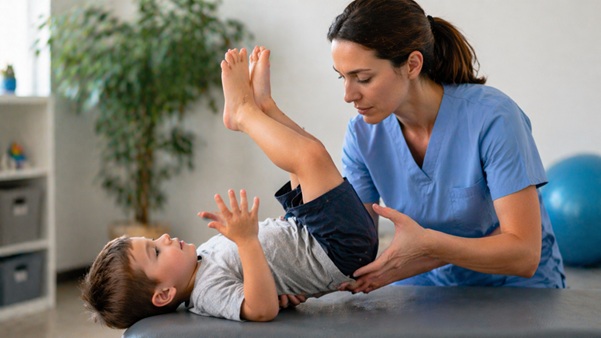
Superior physiotherapy goes beyond encouraging general movement. In a 30-minute session, a therapist assesses static and dynamic balance, along with primitive reflex integration. It is a deep systemic check, much like inspecting a car's suspension rather than just looking at a flat tire.
Therapy sessions are conducted through structured play. Walking on pillows trains the proprioceptive system, while spinning games stimulate the vestibular system. The goal is targeted clinical stimulation disguised as fun.
The Vital Role of Parents at Home
Pediatric therapy continues at home. Ten minutes of structured activity daily is far more effective than a weekly session without follow-up. Parents who consistently apply specific activities at home are the primary drivers of their child's developmental progress.
Help Children Find Their Balance at UNPRI

Treating childhood balance disorders requires the ability to read subtle movement patterns. The Physiotherapy Program at Universitas Prima Indonesia (UNPRI) equips students with developmental neuroscience and pediatric clinical practice from the start.
As the leading university in Sumatra, UNPRI trains students to interpret falling patterns as diagnostic signals and design evidence-based therapies. At UNPRI, we prepare physiotherapists to look beyond surface symptoms and address the root systems, ensuring every child can run and jump with confidence.
News About "Ilmu Kesehatan:"

2026-04-21 10:13:43 by Muhammad Aditya Kurnia
Mengenali Perbedaan Jatuh yang Normal dan Kondisi Medis yang Memerlukan Intervensi.

2026-04-21 10:13:43 by Muhammad Aditya Kurnia
Mengenali Perbedaan Jatuh yang Normal dan Kondisi Medis yang Memerlukan Intervensi.

2026-04-21 10:13:43 by Muhammad Aditya Kurnia
Mengenali Perbedaan Jatuh yang Normal dan Kondisi Medis yang Memerlukan Intervensi.

2026-04-21 10:13:43 by Muhammad Aditya Kurnia
Mengenali Perbedaan Jatuh yang Normal dan Kondisi Medis yang Memerlukan Intervensi.

2026-04-21 10:13:43 by Muhammad Aditya Kurnia
Mengenali Perbedaan Jatuh yang Normal dan Kondisi Medis yang Memerlukan Intervensi.
Other News

2026-04-21 10:13:43 by Muhammad Aditya Kurnia
Mengenali Perbedaan Jatuh yang Normal dan Kondisi Medis yang Memerlukan Intervensi.

2026-04-21 10:13:43 by Muhammad Aditya Kurnia
Mengenali Perbedaan Jatuh yang Normal dan Kondisi Medis yang Memerlukan Intervensi.

2026-04-21 10:13:43 by Muhammad Aditya Kurnia
Mengenali Perbedaan Jatuh yang Normal dan Kondisi Medis yang Memerlukan Intervensi.

2026-04-21 10:13:43 by Muhammad Aditya Kurnia
Mengenali Perbedaan Jatuh yang Normal dan Kondisi Medis yang Memerlukan Intervensi.
2026-04-21 10:13:43 by Muhammad Aditya Kurnia
Mengenali Perbedaan Jatuh yang Normal dan Kondisi Medis yang Memerlukan Intervensi.